<?xml version="1.0" encoding="utf-8"?><feed xmlns="http://www.w3.org/2005/Atom" ><generator uri="https://jekyllrb.com/" version="3.10.0">Jekyll</generator><link href="/feed.xml" rel="self" type="application/atom+xml" /><link href="/" rel="alternate" type="text/html" /><updated>2026-09-23T15:30:08+00:00</updated><id>/feed.xml</id><title type="html">Jamie Fravel</title><subtitle>Jamie&apos;s profesional website and blog. Contains teaching materials in addition to research and software resources.</subtitle><entry><title type="html">LaTeX Package Release: lpalign v1.7</title><link href="/software/2026/07/19/lpalign-v1.7.html" rel="alternate" type="text/html" title="LaTeX Package Release: lpalign v1.7" /><published>2026-07-19T12:15:42+00:00</published><updated>2026-07-19T12:15:42+00:00</updated><id>/software/2026/07/19/lpalign-v1.7</id><content type="html" xml:base="/software/2026/07/19/lpalign-v1.7.html"><![CDATA[<p>I wrote a package and it is finally good enough to share! 
<a href="https://github.com/jfravel/lpalign"><i class="fa-brands fa-github"></i> git link</a></p>

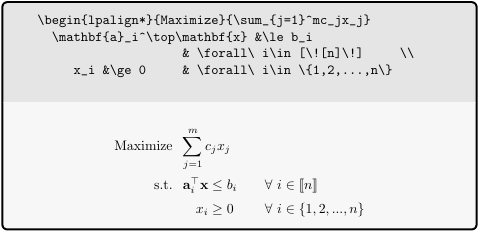
<p>My goal was to simplify the typesetting of mathematical programs by emulating amsmath’s alignment environments with a load of formatting features and without any the extra spacing characters. See the example below!</p>

<p><img src="/assets/lpalign.png" alt="Image" /></p>

<p>I’ve embedded the documentation below. I’d love to hear any feedback you might have!
It has not yet been added to CTAN, so it will need to be added to your project directory manually. (Don’t worry; it is quite simple!)</p>

<object data="/assets/lpalign-Documentaion-v1.7.pdf" width="600" height="800" type="application/pdf"></object>]]></content><author><name></name></author><category term="software" /><summary type="html"><![CDATA[I wrote a package and it is finally good enough to share! git link]]></summary></entry></feed>